Methanol | Production Methods and Applications

Methanol (CH3OH), the simplest member of the alcohol family, plays a pivotal role in the chemical industry, alternative fuels, and even space exploration. Often referred to as wood alcohol, this colorless and volatile liquid is recognized as both a powerful industrial solvent and a primary precursor for valuable chemical derivatives. This article explores the various dimensions of methanol, from its production and diverse applications to its environmental benefits and safety risks.
History and Physico-Chemical Properties
Methanol was first obtained in the 17th century through the destructive distillation of wood—a process where wood was heated in an oxygen-deprived environment. Today, however, industrial methanol is primarily produced from Synthesis Gas (Syngas), a mixture of carbon monoxide (CO) and hydrogen (H2), using copper-zinc-alumina catalysts.
At room temperature, methanol is a colorless liquid with a pungent odor. It has a boiling point of 64.7∘C and is readily soluble in water and organic solvents. Despite its visual similarity to ethanol, methanol is highly toxic; ingestion of even small amounts can lead to permanent blindness or death.
Production Methods: From Syngas to Green Methanol
- Traditional Method (Wood Distillation): Now obsolete due to low efficiency, this method is only used in niche historical contexts.
- Industrial Synthesis from Natural Gas: In modern facilities, natural gas (methane) undergoes Steam Reforming to become Syngas. It is then converted to methanol under 50–100 atmospheres of pressure in the presence of a catalyst. This method boasts an efficiency of up to 99%.
- Green Methanol: To reduce the carbon footprint, researchers have developed "Renewable Methanol." This involves producing hydrogen via water electrolysis using renewable energy and capturing carbon dioxide (CO2) from the atmosphere or industrial emissions to serve as a carbon-neutral fuel.
Wide-Ranging Applications
- Chemical Industry: Over 40% of global methanol is used to produce Formaldehyde, a precursor for resins, plastics, and paints.
- Vehicle and Power Plant Fuel: With a high octane rating of 100, methanol is used in internal combustion engines—either blended with gasoline (e.g., M85) or used directly. It also serves as a diesel substitute in combined cycle power plants.
- Fuel Cells: In Direct Methanol Fuel Cells (DMFC), it acts as a hydrogen source for electricity generation.
- Industrial Solvent: Used in the manufacturing of lacquers, adhesives, and printing inks.
- Antifreeze: Its low freezing point (−97∘C) makes it useful in cooling systems.
Methanol and the Environment
Compared to traditional fossil fuels, methanol emits significantly less CO2 during combustion and produces no particulate matter or sulfur oxides (SOx).
Sustainable Solutions include:
- Recycling carbon from cement plants or power stations.
- Developing Direct Air Capture (DAC) technology to provide CO2 for synthesis.
- Utilizing Green Hydrogen produced from wind or solar-powered electrolysis.
Toxicity and Safety: The Hidden Dangers
Once ingested, the liver metabolizes methanol into formaldehyde and then formic acid, which attacks the optic nerve and the central nervous system. Symptoms include headache, nausea, and blurred vision. If left untreated (typically with ethanol or fomepizole), it is fatal. In industrial settings, the use of leak sensors and Personal Protective Equipment (PPE) is mandatory.
The Future: From Earth to Space
- Marine Fuel: The International Maritime Organization (IMO) has approved methanol as a low-carbon shipping fuel. Companies like Maersk are currently launching methanol-powered fleets.
- Energy Storage: Converting surplus wind power into methanol (Power-to-X) offers a viable solution for long-term energy storage.
- Space Exploration: NASA is researching methanol as a rocket fuel precursor and a potential energy source on Mars, as it has been detected in comets and other planetary atmospheres.
Conclusion
Despite its simple chemical structure, methanol exhibits immense complexity in its applications. While its toxicity requires rigorous management, its potential to reduce petroleum dependency and carbon emissions is undeniable. As decarbonization technologies advance, methanol is set to become a pillar of the future low-carbon economy.
-
Acetic Acid and the Role of Saba Shimi Mehr in Chemical Industries
Acetic acid (CH3COOH) is one of the most critical chemical compounds in the industry. Due to its unique properties, it is utilized across diverse sectors ranging from food production to pharmaceuticals. Known commonly as ethanoic acid, this weak acid is recognized as a fundamental building block in the synthesis of organic compounds. In Iran, leading companies such as Saba Shimi Mehr play a key role in meeting domestic industrial demands by focusing on the production and distribution of high-quality chemicals. By leveraging modern technologies, this company produces and supplies acetic acid in accordance with global standards.
-
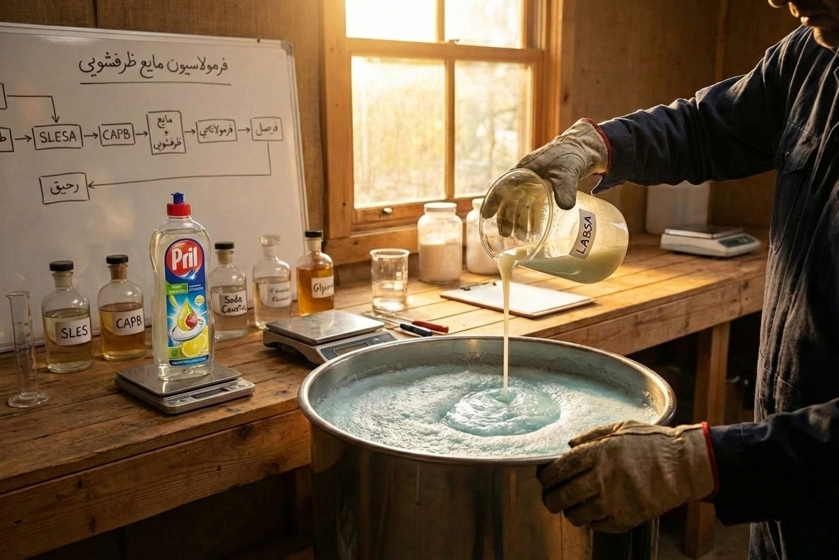
how to make dish washer
The materials needed to make the dishwashing liquid formulation are: linear alkylbenzene sulfonic acid (LABSA), sodium hydroxide (caustic soda), cocoamidopropyl betaine (CAPB), coconut diethanolamide (CDEA), sodium lauryl ether sulfate (SLES), Sodium Lauryl Sulfate (SLES), Propylene Glycol, Glycerin, Color, Fragrance and Water.
-
how to make hair shampoo
Do you want to produce shampoo for a specific type of hair? Oily hair, dry hair, dandruff, etc.? While essentially the same formula is required to produce all of the above products, you can add and modify specific ingredients for specific markets. The AustraLab program includes many shampoos, conditioners, styling aids and finished product formulas that you can tweak to create endless combinations. You can start your own profitable business as a private label hair care manufacturer or make conditioners and shampoos for your salon.
-
how to make toilet liquid
Commercial and economic grade liquid soap formulation The ingredients required to make the liquid toilet soap formulation are: water, sodium lauryl ether sulfate (70%), sodium lauryl sulfate, softener, foam enhancer, skin softener, vitamin E, glycerin acid, glycerin, glycerin, glycerin, Glycerin, glycerin and fatty acids, fragrance